
Alibaba Qwen Team Releases Qwen3.5-397B MoE Model with 17B Active Parameters and 1M Token Context for AI agents
Alibaba Cloud just updated the open-source landscape. Today, the Qwen team released Qwen3.5, the newest generation of their large language model (LLM) family. The most powerful version is Qwen3.5-397B-A17B. This model is a sparse Mixture-of-Experts (MoE) system. It combines massive reasoning power with high efficiency.
Qwen3.5 is a native vision-language model. It is designed specifically for AI agents. It can see, code, and reason across 201 languages.
The Core Architecture: 397B Total, 17B Active
The technical specifications of Qwen3.5-397B-A17B are impressive. The model contains 397B total parameters. However, it uses a sparse MoE design. This means it only activates 17B parameters during any single forward pass.
This 17B activation count is the most important number for devs. It allows the model to provide the intelligence of a 400B model. But it runs with the speed of a much smaller model. The Qwen team reports a 8.6x to 19.0x increase in decoding throughput compared to previous generations. This efficiency solves the high cost of running large-scale AI.

Efficient Hybrid Architecture: Gated Delta Networks
Qwen3.5 does not use a standard Transformer design. It uses an ‘Efficient Hybrid Architecture.’ Most LLMs rely only on Attention mechanisms. These can become slow with long text. Qwen3.5 combines Gated Delta Networks (linear attention) with Mixture-of-Experts (MoE).
The model consists of 60 layers. The hidden dimension size is 4,096. These layers follow a specific ‘Hidden Layout.’ The layout groups layers into sets of 4.
- 3 blocks use Gated DeltaNet-plus-MoE.
- 1 block uses Gated Attention-plus-MoE.
- This pattern repeats 15 times to reach 60 layers.
Technical details include:
- Gated DeltaNet: It uses 64 linear attention heads for Values (V). It uses 16 heads for Queries and Keys (QK).
- MoE Structure: The model has 512 total experts. Each token activates 10 routed experts and 1 shared expert. This equals 11 active experts per token.
- Vocabulary: The model uses a padded vocabulary of 248,320 tokens.
Native Multimodal Training: Early Fusion
Qwen3.5 is a native vision-language model. Many other models add vision capabilities later. Qwen3.5 used ‘Early Fusion’ training. This means the model learned from images and text at the same time.
The training used trillions of multimodal tokens. This makes Qwen3.5 better at visual reasoning than previous Qwen3-VL versions. It is highly capable of ‘agentic’ tasks. For example, it can look at a UI screenshot and generate the exact HTML and CSS code. It can also analyze long videos with second-level accuracy.
The model supports the Model Context Protocol (MCP). It also handles complex function-calling. These features are vital for building agents that control apps or browse the web. In the IFBench test, it scored 76.5. This score beats many proprietary models.

Solving the Memory Wall: 1M Context Length
Long-form data processing is a core feature of Qwen3.5. The base model has a native context window of 262,144 (256K) tokens. The hosted Qwen3.5-Plus version goes even further. It supports 1M tokens.
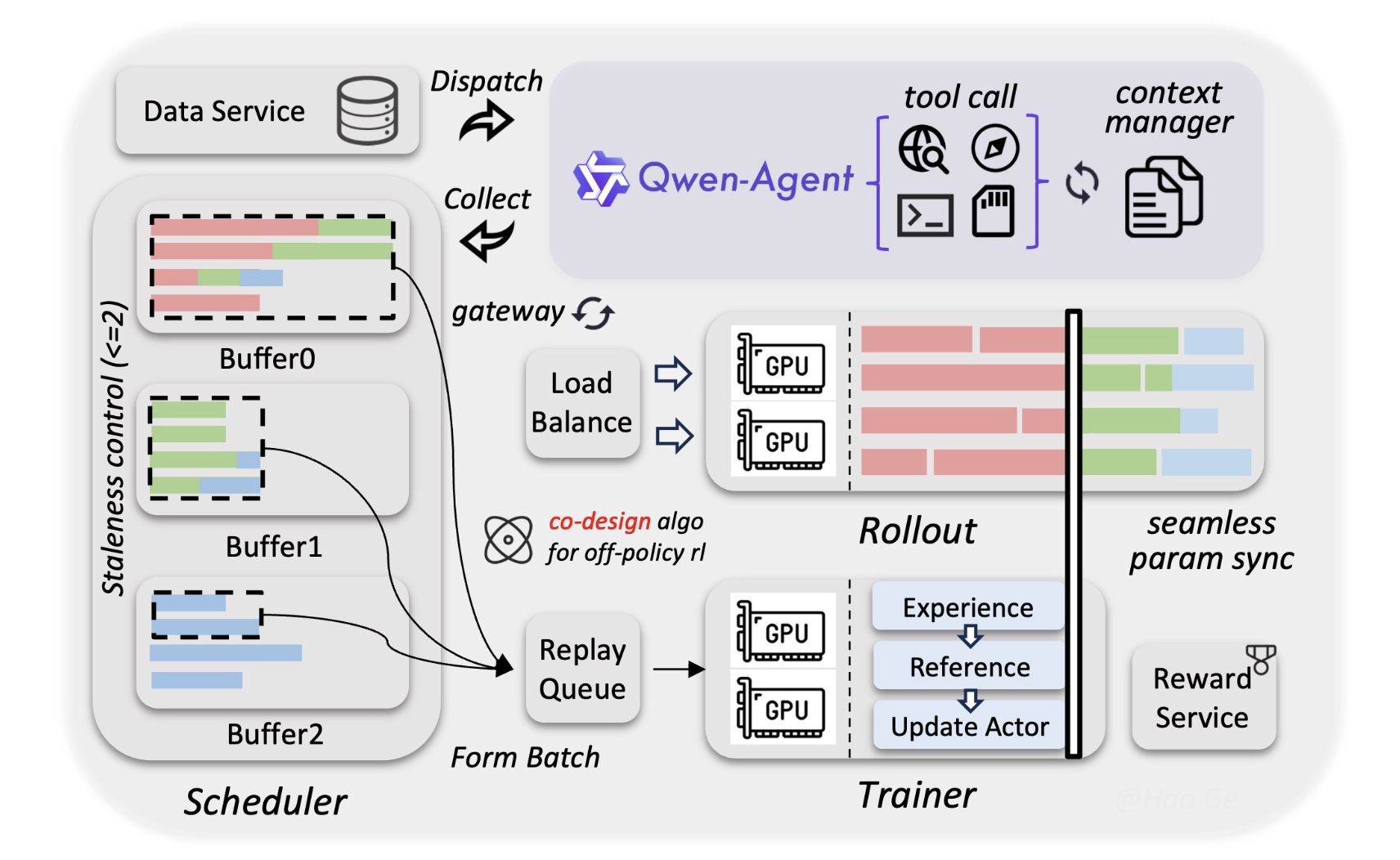
Alibaba Qwen team used a new asynchronous Reinforcement Learning (RL) framework for this. It ensures the model stays accurate even at the end of a 1M token document. For Devs, this means you can feed an entire codebase into one prompt. You do not always need a complex Retrieval-Augmented Generation (RAG) system.
Performance and Benchmarks
The model excels in technical fields. It achieved high scores on Humanity’s Last Exam (HLE-Verified). This is a difficult benchmark for AI knowledge.
- Coding: It shows parity with top-tier closed-source models.
- Math: The model uses ‘Adaptive Tool Use.’ It can write Python code to solve math problems. It then runs the code to verify the answer.
- Languages: It supports 201 different languages and dialects. This is a big jump from the 119 languages in the previous version.
Key Takeaways
- Hybrid Efficiency (MoE + Gated Delta Networks): Qwen3.5 uses a 3:1 ratio of Gated Delta Networks (linear attention) to standard Gated Attention blocks across 60 layers. This hybrid design allows for an 8.6x to 19.0x increase in decoding throughput compared to previous generations.
- Massive Scale, Low Footprint: The Qwen3.5-397B-A17B features 397B total parameters but only activates 17B per token. You get 400B-class intelligence with the inference speed and memory requirements of a much smaller model.
- Native Multimodal Foundation: Unlike ‘bolted-on’ vision models, Qwen3.5 was trained via Early Fusion on trillions of text and image tokens simultaneously. This makes it a top-tier visual agent, scoring 76.5 on IFBench for following complex instructions in visual contexts.
- 1M Token Context: While the base model supports a native 256k token context, the hosted Qwen3.5-Plus handles up to 1M tokens. This massive window allows devs to process entire codebases or 2-hour videos without needing complex RAG pipelines.
Check out the Technical details, Model Weights and GitHub Repo. Also, feel free to follow us on Twitter and don’t forget to join our 100k+ ML SubReddit and Subscribe to our Newsletter. Wait! are you on telegram? now you can join us on telegram as well.
The post Alibaba Qwen Team Releases Qwen3.5-397B MoE Model with 17B Active Parameters and 1M Token Context for AI agents appeared first on MarkTechPost.
from MarkTechPost https://ift.tt/V4vD3mJ
via IFTTT


Comments
Post a Comment